
Mass Law Blog
Intellectual property and business litigation, Massachusetts and nationallyWritten by humans
Lee Gesmer’s Mass Law Blog began in 2005, and contains almost 600 posts. The site initially focused on Massachusetts law, but today it follows business and intellectual property law nation-wide. The site is hosted by Gesmer Updegrove LLP, a law firm based in Boston, Massachusetts. The firm represents startup and established companies in the areas of litigation, transactions (including financings, mergers and acquisitions), IP rights, taxation, employment law, standards consortia, business counseling and open source development projects and foundations. You can find a summary of the firm’s services here. To learn how Gesmer Updegrove can help you, contact: Lee Gesmer
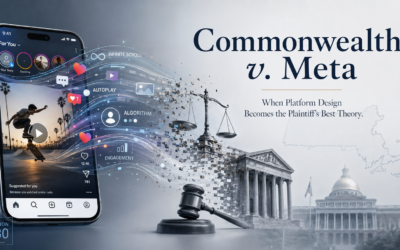
Commonwealth v. Meta: When Platform Design Becomes the Plaintiff’s Best Theory
“No provider or user of an interactive computer service shall be treated as the publisher or speaker of any information provided by another information content provider.” Section 230 of the Communications Decency Act of 1996 I've written about Section 230 many times over the years on this blog, and the arc those posts trace is worth pausing on before turning to where the law stands today. In Section 230 Supreme Court Argument in Gonzalez v. Google: Keep An Eye on Justice Thomas and Supreme...
Is Embedding Someone Else’s Image Copyright Infringement? The Fifth Circuit May Finally Tell Us
On June 2, 2026, the Fifth Circuit heard argument in Emmerich Newspapers, Inc. v. Particle Media, Inc., the first time a federal court of appeals outside the Ninth Circuit has had to decide whether embedding content that lives on someone else's server infringes the copyright owner's exclusive right of public display. I took up that question in 2018 (Is In-Line Linking Illegal Now?) and again in 2022, in a post titled "Is 'Photo Embedding' Copyright Infringement? It Depends on the Court." My...
IBR and Fair Use: What Congress Needs to Fix in the Pro Codes Act
Lee Gesmer and Andrew Updegrove In 2023, we wrote about the D.C. Circuit's decision in American Society for Testing and Materials v. Public.Resource.Org (ASTM II), which held that a nonprofit organization's free online publication of technical standards incorporated by reference (IBR) into law constituted copyright fair use. We expressed concern that the decision underestimated the threat to the delicate symbiotic relationship between standards development organizations (SDOs) and the...
Why Bother With the DMCA? The Supreme Court’s Sony v. Cox Decision and Its Consequences
This post is the third in a series following Sony Music Entertainment v. Cox Communications through the courts. In May 2024 I wrote about the Fourth Circuit's decision, which reversed a $1 billion jury verdict against Cox on vicarious liability grounds while affirming a finding of contributory infringement, and sent the case back for a new trial on damages. Last November, when the Supreme Court agreed to hear Cox's appeal, I warned that the stakes extended far beyond the parties themselves. On...
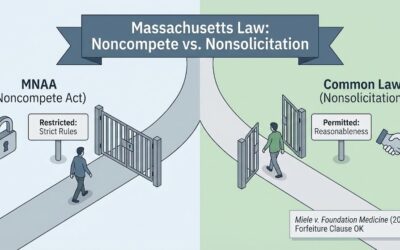
The Massachusetts Noncompetition Agreement Act and Nonsolicitation Agreements: Miele v. Foundation Medicine
When the Massachusetts Noncompetition Agreement Act (MNAA) took effect in October 2018, I described the law in detail and wrote that employers and employees were entering “a new era” in noncompete law. The statute imposed formalities, created new employee protections, and limited the enforceable duration of noncompetes. But it also drew a set of carefully worded exclusions - most notably for nonsolicitation agreements. I predicted that those exclusions would become critical as employers...
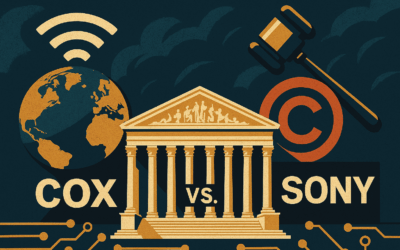
Sony v. Cox Heads to the Supreme Court
Update: On March 26, 2026 the Supreme Court decided this case in favor of Cox. The Court held that an internet service provider would be liable for infringing content posted by a third party only when it induced users' infringement or provided a service "tailored to infringement." **************** Can your internet provider be held liable for what you download? That's the question the Supreme Court will wrestle with on December 1, when it hears Sony Music Entertainment v. Cox Communications -...

This site is hosted by Gesmer Updegrove LLP, a technology law firm based in Boston, Massachusetts. You can find a summary of our services here. To learn how GU can help you, contact:
Lee Gesmer