
Mass Law Blog
Intellectual property and business litigation, Massachusetts and nationallyWritten by humans
Lee Gesmer’s Mass Law Blog began in 2005, and contains almost 600 posts. The site initially focused on Massachusetts law, but today it follows business and intellectual property law nation-wide. The site is hosted by Gesmer Updegrove LLP, a law firm based in Boston, Massachusetts. The firm represents startup and established companies in the areas of litigation, transactions (including financings, mergers and acquisitions), IP rights, taxation, employment law, standards consortia, business counseling and open source development projects and foundations. You can find a summary of the firm’s services here. To learn how Gesmer Updegrove can help you, contact: Lee Gesmer

The Celestial Jukebox: Copyright Law and the Business of Music
“The absolute transformation of everything that we ever thought about music will take place within 10 years, and nothing is going to be able to stop it. I see absolutely no point in pretending that it's not going to happen. I'm fully confident that copyright, for instance, will no longer exist in 10 years.” - David Bowie, 2002 In 1994, Stanford copyright scholar Paul Goldstein coined a phrase that captured the imagination of anyone following the collision between music and technology. He...

Did Anthropic Waive Attorney-Client Privilege?
Update: the same day I posted this article Bartz and Anthropic announced that they had settled the case. The terms are as yet unknown, and the settlement will need to be approved by the judge. However, this topic is not moot - it could easily arise in one of the many genAI copyright cases still pending. The eyes of the artificial intelligence community are laser-focused on the upcoming class action damages trial in Bartz v. Anthropic, scheduled for December 1, 2025. This will be the first...
Fair Use or Theft? The Copyright War Behind Generative AI
The United States is in a race to achieve global dominance in artificial intelligence (AI). Whoever has the largest AI ecosystem will set global AI standards and reap broad economic and military benefits. Just like we won the space race, it is imperative that the United States and its allies win this race. . . . Build, Baby, Build. America's AI Action Plan, July 2025 The explosion of generative AI has triggered a legal crisis that few saw coming and nobody seems equipped to fix. At the center...
Kadrey v. Meta: Will Market Dilution Reshape AI Copyright Law?
The recent blockbuster decisions in Bartz v. Anthropic and Kadrey v. Meta have raised a number of important and controversial issues. On the facts, both cases held that using copyright-protected works to train large language models was fair use. Still, AI industry executives shouldn’t be too quick to celebrate. Bartz held that Anthropic is liable for creating a library of millions of works downloaded illegally from "shadow libraries," and it could be facing hundreds of millions of dollars in...

Reddit v. Anthropic: Contract Law as the New Frontier in AI Data Governance
At the heart of large language model (LLM) technology lies a deceptively simple triad: compute, algorithms, and data. Compute powers training - vast arrays of graphics processing units crunching numbers at a scale measured in billions of parameters and trillions of tokens. Algorithms shape the intelligence - breakthroughs like the Transformer architecture enable models to understand, predict, and generate human-like text. Data is the raw material, the fuel that teaches the models everything...
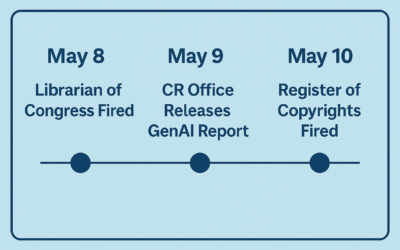
Did a Landmark AI-Copyright Report Trigger a Political Purge?
[Update: Perlmutter's challenge to her termination was rejected by a district court judge on July 30, 2025. However, on September 10, 2025 the DC Circuit reversed that ruling and issued an injunction ordering that Perlmutter be reinstated as Register of Copyrights: In sum, all of the preliminary-injunction factors weigh in favor of granting an injunction pending appeal. Perlmutter has shown a likelihood of success on the merits of her claim that the President’s attempt to remove her from her...

This site is hosted by Gesmer Updegrove LLP, a technology law firm based in Boston, Massachusetts. You can find a summary of our services here. To learn how GU can help you, contact:
Lee Gesmer