by Lee Gesmer | Jul 29, 2008 | Procedure
One of the things that drives people crazy is how easy it is to file a lawsuit, and conversely how difficult it is to persuade a judge to dismiss a lawsuit before the defendant incurs the costs of discovery and summary judgment. It has long been the law in Massachusetts that a complaint should not be dismissed “unless it appears beyond doubt that the plaintiff can prove no set of facts in support of his claim which would entitle him to relief.” Nader v. Citron, 372 Mass. 96 (1977). This is a very difficult (some would say metaphysical) standard. Under it dismissal has been limited to black and white situations where the plaintiff has failed to allege the basic elements of a cause of action, or where (for example) a statute of limitations defense is apparent on the face of the complaint.
No more. Last year the U.S. Supreme Court rejected this standard in the federal court (Bell Atlantic Corp. v. Twombly), holding that a complaint (the document that initiates a lawsuit) must assert a claim to relief that is “plausible on its face.” The complaint must allege facts plausibly suggesting a right to relief. Vague assertions intended to satisfy the “no set of facts” standard will no longer suffice.
The Massachusetts state courts often follow the federal courts when it comes to matters of procedure, and in June the Supreme Judicial Court expressly adopted the Twombly standard in Iannachino v. Ford Motor Company (“we take the opportunity to adopt the refinement of that standard that was recently articulated by the United States Supreme Court in . . . Twombly“).
Of course, the devil is in the details when it comes to how specific, detailed and complete a set of facts must be to plausibly suggest a particular plaintiff’s right to relief. The lower federal courts are struggling to apply the Twombly standard in various contexts, and I expect a similar process to take place in the state courts in the coming years. One thing is certain, however – filing a complaint in state court has just gotten more difficult, and the chances of obtaining early dismissal has improved for defendants.
by Lee Gesmer | Jul 26, 2008 | Litigation
It’s probably fair to say that there are thousands of software license and development agreements entered into every business day in the U.S. Only a very small number result in a lawsuit, and an even smaller number end up with a jury verdict and ruling under 93A by a Massachusetts trial judge. So, when a case does go the distance, it’s worth paying attention.
The recent decision by Massachusetts Superior Court Judge Leila R. Kern in Perfectyourself.com v. Accusoft Corporation discusses the evidence in a jury trial that resulted in a more than $400,000 verdict against Accusoft. In Massachusetts the trial judge, not the jury, decides claims under M.G.L. c. 93A, Massachusetts’ “little FTC Act.” Depending on the violation, Chapter 93A allows the judge to award double or treble damages and attorney’s fees to the prevailing plaintiff. The Accusoft decision is the trial judge’s discussion and analysis of the evidence that the jury heard for purposes of her analysis and decision under 93A.
The evidence at trial is a common story, although it rarely leads to a jury trial and judgment. Accusoft contracted with Perfectyourself.com to develop a software application. Accusoft represented that it had much of the underlying technology already in place, a claim that the jury and judge found to be untrue. After Accusoft was unable to deliver an acceptable prototype to Perfectyourself a standoff developed – “pay us” – “we’ll pay you when you deliver” – “no, you pay us first, then we’ll deliver”. Eventually Perfectyourself filed suit.
Massachusetts General Laws c. 93A makes unlawful all “unfair or deceptive acts or practices in the conduct of any trade or commerce.” The trial judge held that 93A could be violated even if there was no “intent to deceive,” and even if the defendant didn’t know that the representation was false, so long as the misrepresentation was “reasonably capable of ascertainment.” This conduct qualifies as a “negligent misrepresentation” and is a violation of 93A.
The judge did not find Accusoft’s violation to be “willful and knowing,” and therefore declined to impose multiple damages (93A allows for two or three times actual damages, at the discretion of the trial judge, based on her evaluation of the severity of the defendant’s conduct). She did, however, award Perfectyourself its reasonable attorneys fees, as the statute required her to do once a violation was found.
The moral of the story? The sales staff of a software company has to be careful not to overstate the facts when making a sale to a potential customer. The temptation to do so can be great in a competitive situation where commissions for the salesperson is on the line. Sometimes the sentiment is “sell today, worry about delivering tomorrow.”
A client might ask, “is there any way that this kind of a situation can be avoided by using the typical contractual disclaimers and limitations and liability? With one exception the answer is no, there is no contractual “silver bullet” that will insulate a software vendor from liability under all circumstances. It’s well-established law in Massachusetts that integration and non-reliance clauses are no a defense to fraud, although they may be grounds to avoid a claim of negligent misrepresentation of the sort found in the Accusoft case. However, it is exceedingly difficult to defend a claim of outright, knowing fraud by relying on contract limitations.
The one exception is this: if the signed contract addresses a specific element of performance, the customer cannot claim fraud based on a pre-contract representation with respect to that element. Some examples:
- If the contract states that the software development project will be completed in stages with specific dates assigned, a claim of fraud based on different pre-contract promised dates will not succeed.
- If the contract states that the software will operate at certain speeds (a common issue in software deals), a claim that the salesman made different pre-contract representations will not stand.
The rationale behind this distinction is that integration and non-reliance provisions are boilerplate, and contracting parties generally don’t pay much attention to them – in fact, they are often thown in at the last minute, and not negotiated at all. However, if the contract addresses a specific, material aspect of the project, such as completion dates and performance metrics, the customer is presumed to have read these terms, and cannot reasonably claim to rely on prior represenations that conflict with the express terms of contract.
- The “mother of all software breach/fraud cases” in Massachusetts is VMark Software, Inc. v. EMC Corp., 37 Mass.App.Ct. 610 (1994)
- The leading case for the proposition that a party may not base a claim of fraud on oral representations that are directly at odds with the contract provision is Turner v. Johnson & Johnson, 809 F.2d 90, 95 (1st Cir. 1986).
by Lee Gesmer | Jul 24, 2008 | Copyright
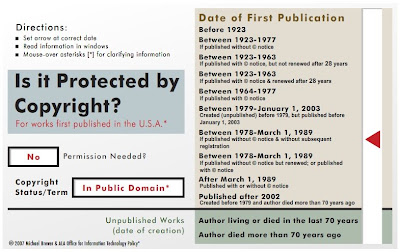
Whether a U.S. work is protected by U.S. copyright is often a difficult question to answer. It can depend on factors such date of first publication, whether the work was published with a copyright notice, whether the copyright was renewed, whether the author is living or dead and, if dead, when the author died. Technology to the rescue!, sort of ….
Click on the graphic below to go to the American Library Association “Copyright Advisory Network” website where you can use the “digital slide rule” created by Michael Brewer (ALA member from the University of Arizona Library) to find the answer. Drag the red arrow up and down beside the various data points and see what the boxes to the left say (yes, no, maybe). Of course, “maybe” is the answer far too often, requiring the user to click the asterisk, read the explanation, do more research and …. oh well.
by Lee Gesmer | Jul 23, 2008 | Litigation, Procedure
What do lawyers fear the most? Spiders, snakes, public speaking, death by auto de fe?
Well, I’ll be darned if I know, but one thing that scares the bejesus out of all thinking lawyers is waiver. Lawyers start to become vaguely aware of this horror in law school. Once they go out into practice it slowly dawns on them that it’s ultimately undefinable, that it lurks behind every legal shrub and tree, that opposing counsel will throw it in your face when you least expect it and long after you can fix it, and that if they don’t a court may do so on its own initiative. In its most severe forms it can lead to bankruptcy, scandal, and even malpractice (apologies to Jimmy Stewart).
Take a simple summary judgment motion in federal court. Unbeknownst to the novice lawyer, this process is fraught with dangers. The defendant files the motion. You file an opposition. The defendant files a reply affidavit introducing new facts. You lose the motion, and on appeal you argue that it was inappropriate for the defendant to introduce new facts in its reply. You cite the “no new facts” rule. After all, you were sandbagged by that reply, and the court shouldn’t have relied upon it.
Not so fast, the First Circuit recently held on these facts – did you raise this with the district court and object to the new evidence? If not you have waived the right to raise this on appeal. Desrosiers v. Hartford Life (2008). You lose.
A simple, one page motion to strike that could have been drafted and filed in an hour would have saved the day. For want of a nail …
Waiver, one of the most dreaded words a lawyer can hear. And so it goes.
by Lee Gesmer | Jul 22, 2008 | Antitrust, Technology
Nvidia has filed a Sherman Act complaint against Rambus in federal district court in North Carolina. The allegations appear to echo (copy?) the allegations in the FTC case I reported on recently, where the D.C. Circuit reversed the FTC’s finding of illegal monopolization by Rambus. Can Rambus file a successful motion to dismiss in this new case based on the D.C. Circuit’s decision? Very likely.
Why did Nvidia file this suit? My first thought is that Nvidia was concerned about a statute of limitations problem, and this filing (even if dismissed by the District Court) will allow them to appeal and keep their claims alive during the FTC’s motion for en banc review that is pending before the D.C. Circuit, and during a possible Supreme Court appeal by the FTC. Alternatively, they may be hoping that a district court in the Fourth Circuit (or even the Fourth Circuit itself), will see things differently from the D.C. Circuit, and allow their case to proceed.

